 Magiceden
 lets users buy and sell Solana NFTs through listings and offers
Magiceden lets users discover, buy and sell Solana NFTs, with marketplace fees reducing a seller’s sale proceeds. An NFT is a blockchain token identifying a particular collectible. Purchases, offers and automated trading pools serve different tasks, while Packs and Lucky Buy add randomized outcomes.
Bottom line: Seller proceeds reflect the completed sale’s marketplace deductions, so a listing price alone does not establish the amount received.
Prepare a Solana NFT sale
A Solana NFT sale requires access to the wallet holding the asset and enough SOL for any network fees it pays. The profile’s My Items area groups holdings by collection; selecting the intended NFT opens its pricing and transaction details. Check the exact item before authorizing its sale. An ordinary listing advertises the NFT at the seller’s chosen price. Bulk listing supports multiple Solana NFTs, with either individual prices or a shared price. The listing remains an offer to sell until a purchase completes; publishing it produces no sale proceeds. Selecting Delist on the NFT’s item details page starts cancellation. Check that the listing is no longer active and you still own the NFT.
Instant Sell accepts an active collection offer covering the selected NFT, provided the item qualifies. Review the quoted proceeds before approval. A successful sale transfers the NFT and records the payment.
What reduces a seller’s NFT proceeds?
Marketplace deductions reduce ordinary sale proceeds, while network fees and creator royalties have different recipients and payment rules. The listing price is the gross NFT price. The seller’s transaction preview identifies the platform deduction and expected receipt. Review the applicable fee there, including whether an offer display includes its charges.
Platform deductions and network costs
The ordinary Solana marketplace has no platform listing charge; its transaction fee applies when a sale occurs. Listing transactions can still incur network costs. Solana network transaction fees are paid in SOL. Any network fee the seller pays belongs separately in the accounting.
Creator royalties
Buyers pay their selected creator royalty on top of the listed NFT price in the optional-royalty purchase flow. Sellers receive the listed price minus the platform fee. Collections with enforced royalties do not offer the same payment choice. Offer displays can account for charges differently, so the amount entered into a bid need not equal the amount shown to sellers.
An urgent sale with a cancellation option
In this hypothetical case, a seller needs SOL soon and wants to retain cancellation control before a sale. The correct NFT has an active listing at 3.74 SOL, with a quoted platform deduction of 0.0748 SOL. The wallet profile shows the active listing, and the sale preview shows the quoted charge.
Keeping the listing active allows a buyer to fill it before cancellation succeeds. The buyer’s completed purchase transfers the NFT and produces a sale record identifying the item and payment.
Subtracting the quoted deduction gives 3.74 SOL minus 0.0748 SOL, or 3.6652 SOL in seller proceeds before separately accounting for network costs. The seller compares the recorded receipt with the receiving wallet’s credit, accounting for any network fee they actually paid.
A different deduction would change the proceeds, and an unfilled listing would provide no payment. The completed sale provides funds and ends the seller’s option to retain the NFT.
Which marketplace services remain available?
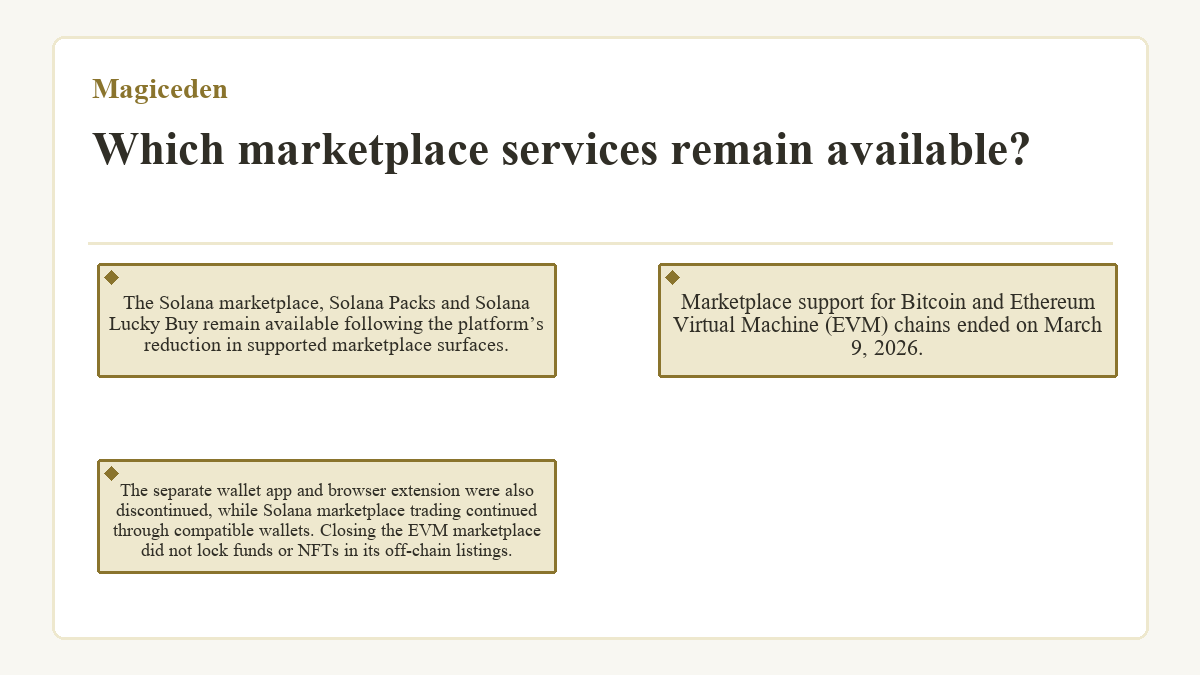
The Solana marketplace, Solana Packs and Solana Lucky Buy remain available following the platform’s reduction in supported marketplace surfaces. Marketplace support for Bitcoin and Ethereum Virtual Machine (EVM) chains ended on March 9, 2026. The separate wallet app and browser extension were also discontinued, while Solana marketplace trading continued through compatible wallets. Closing the EVM marketplace did not lock funds or NFTs in its off-chain listings.
Collection discovery and purchase routes
Collection pages connect NFT discovery with listed purchases, targeted bids and automated trading. Those options differ in item selection and funding.
Listed items and aggregation
A direct purchase targets a particular NFT at its displayed listing price. Solana aggregation lets buyers purchase listings originating on other marketplaces. Sweeping selects multiple available listings, while item traits and collection statistics help distinguish individual collectibles within the same collection. The fee breakdown remains specific to the selected purchase.
Item, trait and collection offers
An item offer targets a particular NFT, while collection offers specify acceptable purchases across a collection with optional trait restrictions. Buyers can set purchase quantities and configure decreasing offer prices. Shared escrow funds can support multiple offers, though insufficient balances make collection offers inactive. Depositing more funds can reactivate unwanted outstanding offers, so funding decisions require attention to existing bids.
Automated trading pools
Automated market maker (AMM) pools let users configure buy orders, sell listings or both sides. Linear or exponential pricing curves determine price changes as orders fill, alongside settings for inventory quantities, starting prices and liquidity-provider fees. Automated execution changes the owner’s NFT inventory and SOL balance as trades fill.
Item identity and settlement records
An NFT’s identifiers distinguish the asset from other tokens using similar names or artwork. Solana item details display available token identifiers, ownership information and attributes, including the frequency of particular traits within a collection. A collection offer can cover several different items, so selecting an NFT with unusual traits can sell it at a collection-wide bid. The intended item and acceptable proceeds belong in the approval decision.
A completed sale has a successful transaction recording the NFT transfer and payment. Its signature provides the identifier used to inspect that record. A confirmed transaction can contain an execution error, and Solana can charge network fees even when the intended transfer fails. A pending status leaves the sale’s outcome unresolved.
Creator Hub and collection management
Creator Hub lets collection managers submit collection listing applications and presentation updates. Solana collections can appear automatically, and creators can claim management access to update their marketplace information. A fully minted collection missing from the marketplace can use the manual listing application, which requires its identifying information and submission details.
The submission requirements distinguish legacy NFTs, Metaplex Core and compressed NFTs, including their different collection or tree identifiers. After gaining management access, a creator can submit collection descriptions and other presentation updates. These controls update the collection’s marketplace entry while holders keep their NFTs.
Packs and Lucky Buy
Packs and Lucky Buy have separate charges and fulfillment conditions.
NFT and Pokémon Packs
NFT Packs reveal a random collection, with a choice between NFT fulfillment and a payout. The displayed choice timer matters: expiry triggers an automatic payout, while confirming Take NFT is final. If NFT fulfillment fails, the buyer receives a payout equal to the revealed collection’s floor price. Drop rates vary by pack. Pokémon Packs reveal tokenized graded cards, with physical redemption handled through Collector Crypt. Their sell-back window is separate from the NFT Pack choice timer. After that window expires, the card remains tradable and physically redeemable but loses eligibility for the Pack sell-back payout.
Lucky Buy commitments
Eligible non-US users can commit SOL through Lucky Buy for a chance at an NFT or selected payout. The feature requires an eligible Solana listing, and its preview shows the commitment and winning probability. A completed losing attempt spends the committed SOL without delivering the target NFT or selected payout; an Open Edition NFT may still be awarded. Refund conditions concern interrupted or invalid attempts, rather than every losing outcome. Lucky Buy’s treasury covers the gap between a successful buyer’s commitment and the NFT’s sale amount, so the commitment alone does not determine the seller’s whole receipt. Choose between purchasing a specified NFT and paying for a randomized outcome before comparing their displayed charges.
Things people ask
-
Does an item-level bid disappear when the NFT is sold or delisted?
- Selling or delisting an NFT does not automatically cancel an item-level bid. The offer’s chosen expiry period and cancellation status remain relevant after the NFT leaves the listings. The buyer sets expiry when creating the bid and can manage outstanding offers through the profile’s Item Offers Made area.
-
Where is my SOL after I cancel an item offer?
- Canceling an item offer leaves its funding in the bidding or escrow wallet by default. The separate Withdraw control transfers escrow funds to the connected main wallet and empties the escrow balance.
-
How can I recover assets from the discontinued wallet?
- An exported private key can restore the original address in a compatible wallet supporting private-key imports. For the discontinued wallet’s Solana account, importing its recovery phrase can produce a different address because of its derivation path. Use the corresponding Solana private key to preserve that address. Local export requires an existing installation still allowing access to its key controls. Anyone possessing the private key can control the account, so migration requires keeping it private.
-
What happens to funds left in a Bitcoin bidding or auction wallet?
- Funds left in those Bitcoin wallets require assistance from marketplace support after the withdrawal window closed. Bitcoin bidding and auction wallets stopped being accessible through the platform after the March 27, 2026 cutoff. Closing their listings did not itself withdraw remaining balances.
-
Can unopened Packs be traded as NFTs?
- Packs themselves are not tradable digital assets. Revealed NFTs delivered to the wallet can be transferred or traded. For NFT Packs, choosing the payout option delivers funds instead of the NFT.
-
When does Lucky Buy return committed SOL?
- Lucky Buy returns committed SOL in specified interrupted-transaction cases, including an item selling or its price increasing before completion. System failure and transaction expiry also qualify for refunds. An ordinary unsuccessful attempt does not qualify merely because the user failed to win the target NFT or payout. The transaction record distinguishes a refunded attempt from a completed losing outcome.
-
Which permissions let a creator claim an auto-listed collection?
- Claiming collection management requires verification from the collection’s update-authority wallets. The claim flow asks for signatures from those wallets, followed by administrator approval of the management transfer. Owning an NFT from the collection does not establish its update authority. A verified wallet display records the signing stage; approval still governs access to the collection’s management controls.